
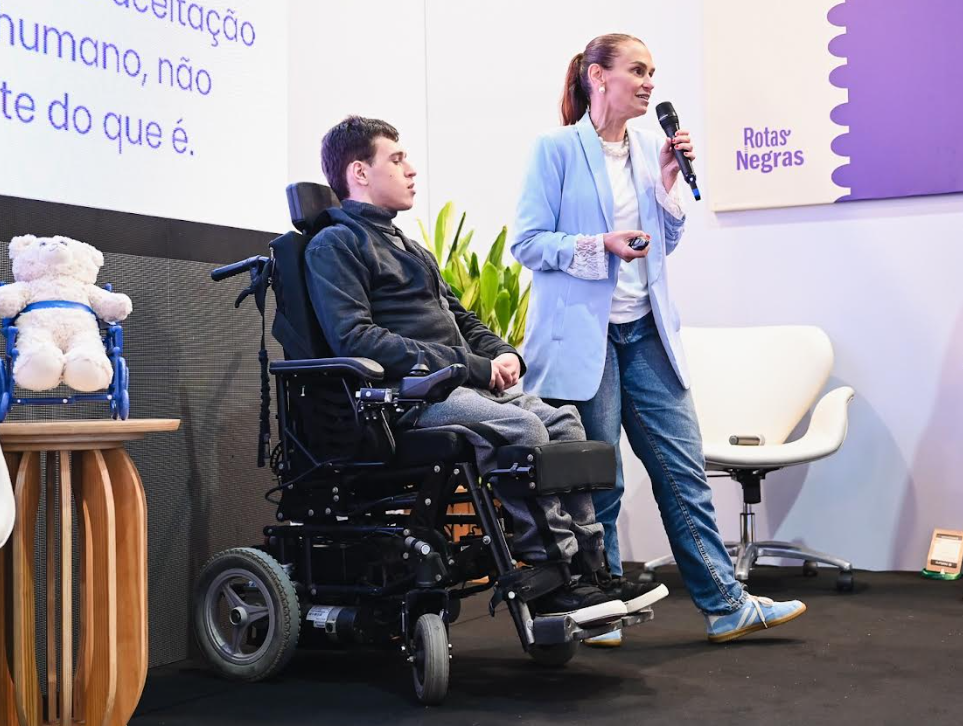
The economic and social potential of accessible tourism was the topic of a lecture given by Pedro Rosinha, president of the Amores Fati Institute, and Martha Rosinha, vice president of the organization, at the Diversity Space of Festuris – Gramado International Tourism Fair.
Amores Fati, a non-profit organization, arose from the experiences of Pedro, who has cerebral palsy, and his mother, who transformed their daily lives and challenges into a purpose. Together, mother and son inspired the creation of an institution dedicated to promoting awareness and inclusion for a future that is more accessible to all.
During the presentation, Martha Rosinha showed data and images that portray mistakes and successes in relation to inclusion and drew attention to the importance of a more sensitive and comprehensive view of the topic. “Many people are unaware of this information, but one in every four people in the country has a disability. We are all equal and all different,” said Martha.
She also emphasized that accessible tourism goes far beyond physical adaptations. “The sector still needs to understand that accessibility is not just about complying with the law and adapting a space. It is about understanding what people experience, what their needs are, and offering a complete experience, like so many we find here in Gramado,” she said.
The speaker pointed out that the concept of accessibility encompasses diverse audiences—such as families with young children, the elderly, and people with obesity—and not just people with disabilities. “Accessible tourism is not just for wheelchair users. We all have limitations or specific needs, and the industry needs to embrace these differences,” she said.
Inspired by the philosophy of Amor Fati — “love fate as it is” — the Institute advocates for the acceptance of life in its entirety and the construction of an inclusive society, with empathy and respect for differences.
























-1.png)